
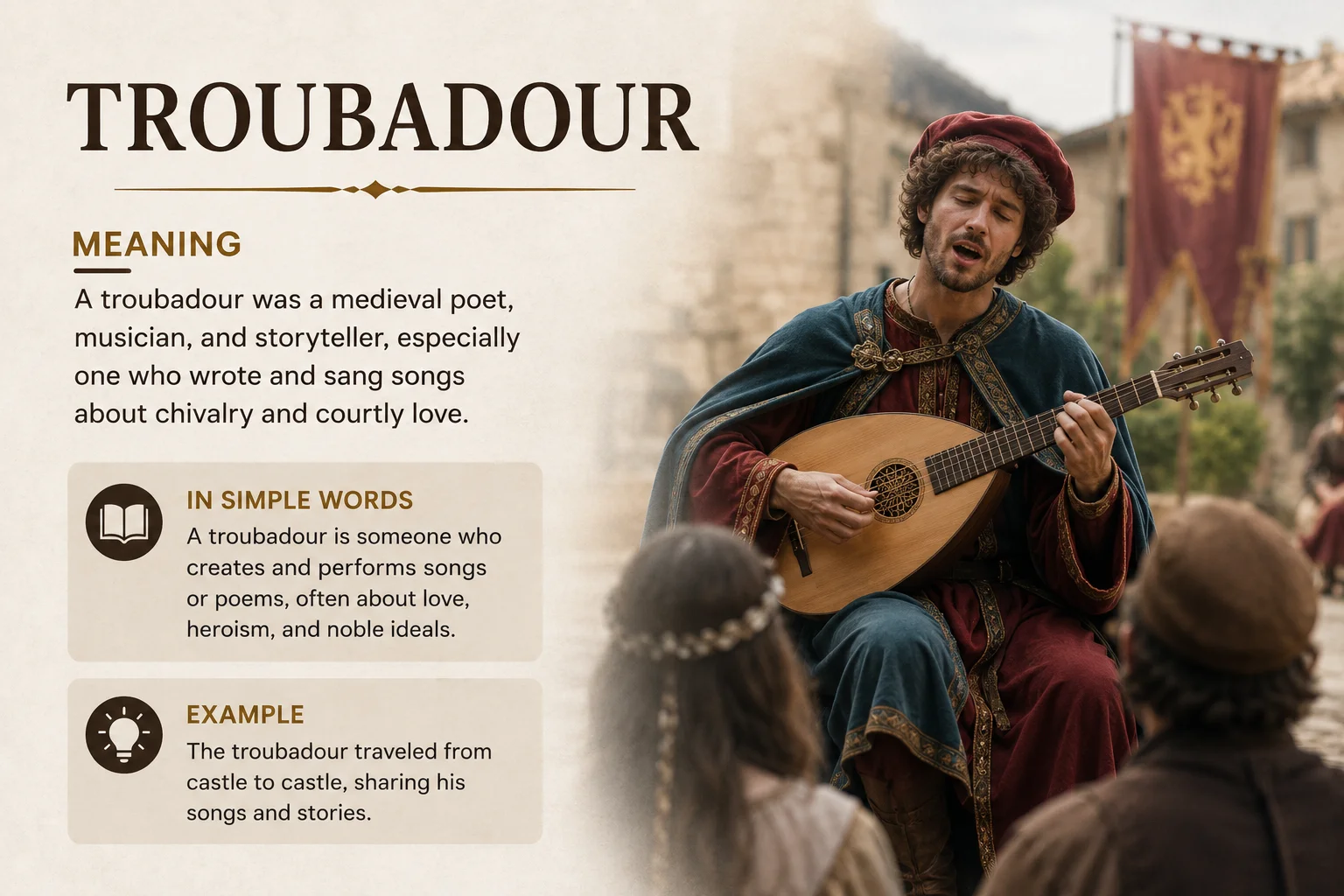
The troubadour meaning is often searched by people who encounter the word in books, songs, movies, and historical discussions. Although it may sound like an old or unusual term, “troubadour” has a rich history and remains relevant in modern English. The word evokes images of traveling musicians, poetic storytellers, and artists who entertain people through music and verse.
In simple terms, a troubadour was originally a poet and musician from medieval Europe who composed and performed songs, often about love, adventure, and chivalry. These performers traveled from place to place, sharing their music and stories with noble courts and ordinary people alike.
Today, the meaning of troubadour has expanded beyond its historical origins. In modern English, the word can describe any singer-songwriter, wandering musician, or artist who uses music and storytelling to connect with people. Many modern performers are sometimes called troubadours because they continue the tradition of expressing emotions and experiences through songs.
The history of troubadours is fascinating because they played an important role in shaping poetry, music, and storytelling traditions that still influence artists today. Their songs explored themes such as romance, loyalty, bravery, and human emotions, making them some of history’s earliest singer-songwriters.
Understanding the troubadour meaning can improve your vocabulary and provide insight into a unique part of cultural and literary history. This guide explains what troubadour means, where the term originated, how it was used historically, examples of modern usage, and why the word continues to capture people’s imagination. For more insight read this:- consort meaning and lpc meaning.
What Does Troubadour Mean?
The troubadour meaning refers to a poet and musician who composed and performed songs, particularly during the medieval period in Europe.
In simple terms, a troubadour was:
- A poet
- A musician
- A songwriter
- A storyteller
- A traveling performer
Examples:
“He lived like a troubadour, traveling from town to town with his guitar.”
“The singer has often been called a modern troubadour.”
“The book tells the story of a medieval troubadour.”
The word usually brings to mind someone who creates artistic works and shares them through music and performance.
The Origin of the Word Troubadour
Understanding the troubadour meaning requires looking at its origins.
The term comes from medieval southern France, particularly from the region known as Provence.
The word likely originated from the Occitan language, where it referred to:
- Composing songs
- Creating poetry
- Inventing artistic expressions
Troubadours first appeared during the 11th century and became highly influential throughout medieval Europe.
Their performances were popular because they combined:
- Poetry
- Music
- Storytelling
- Emotional expression
Over time, the word entered English and came to symbolize artistic musicians and wandering poets.
Although centuries have passed, the romantic image of the troubadour still survives today.
Troubadours in Medieval Europe
The troubadour meaning is closely linked to medieval European history.
During the Middle Ages, troubadours were respected performers who entertained audiences through songs and poetry.
Their responsibilities included:
- Writing poems
- Composing melodies
- Performing music
- Sharing stories
- Preserving cultural traditions
Many troubadours traveled extensively.
They visited:
- Royal courts
- Castles
- Noble households
- Villages
- Festivals
Because books were uncommon and literacy rates were low, music and storytelling served as important forms of entertainment and communication.
Troubadours played a significant role in preserving stories and spreading ideas across different regions.
What Did Troubadours Sing About?
One of the most interesting aspects of the troubadour meaning involves the themes explored in their songs.
Common topics included:
Love
Romantic love was perhaps the most famous subject.
Chivalry
Many songs praised honor and noble behavior.
Adventure
Stories often featured heroic journeys.
Loyalty
Troubadours frequently celebrated faithfulness and devotion.
Nature
Natural beauty inspired numerous songs and poems.
Their performances allowed audiences to experience emotions, ideas, and stories in memorable ways.
The themes explored by troubadours continue appearing in modern music and literature.
Troubadour Meaning in Literature
The troubadour meaning often appears in literary works.
Writers frequently use the word to describe characters who are:
- Musical
- Creative
- Romantic
- Wandering
- Artistic
Examples:
“The young troubadour traveled across the kingdom.”
“He became a troubadour, singing songs of hope and love.”
“The novel follows a wandering troubadour seeking adventure.”
In literature, troubadours often symbolize:
- Freedom
- Creativity
- Emotional expression
- Storytelling traditions
The image of a traveling poet-musician continues to inspire readers and writers around the world.
Troubadour Meaning in Modern English
Although medieval troubadours no longer exist in their original form, the troubadour meaning remains relevant.
Today, the term often refers to:
- Singer-songwriters
- Folk musicians
- Traveling performers
- Musical storytellers
- Independent artists
Examples:
“The singer is considered a modern troubadour.”
“He performs as a troubadour, writing songs about everyday life.”
“Her music has earned her the reputation of a contemporary troubadour.”
The modern usage focuses less on historical roles and more on artistic qualities.
Anyone who creates meaningful songs and shares stories through music may be called a troubadour.
Characteristics of a Troubadour
Understanding the troubadour meaning becomes easier by examining common characteristics.
Troubadours are often:
Creative
They compose original works.
Musical
They perform songs and melodies.
Expressive
They communicate emotions effectively.
Story-Oriented
Their performances often tell stories.
Passionate
They care deeply about their art.
Independent
Many troubadours travel and perform freely.
These qualities explain why the term still appeals to modern audiences.
The word suggests artistic authenticity and emotional connection.
Troubadours and Storytelling
The troubadour meaning is strongly connected to storytelling.
Long before movies, television, and social media, people relied on storytellers for:
- Entertainment
- Education
- Inspiration
- Cultural preservation
Troubadours used songs and poems to:
- Share historical events
- Express emotions
- Teach lessons
- Celebrate heroes
Music made stories easier to remember.
As a result, troubadours helped preserve traditions and ideas for future generations.
Their storytelling abilities continue influencing musicians and writers today.
Troubadours and Music
The troubadour meaning cannot be separated from music.
Music was the heart of their performances.
Troubadours typically:
- Wrote songs
- Played instruments
- Sang poems
- Entertained audiences
Their performances were highly valued because they combined:
- Melody
- Rhythm
- Emotion
- Narrative
Modern singer-songwriters often follow similar traditions.
Many contemporary artists write personal songs that tell stories and explore human emotions.
For this reason, the term “troubadour” still feels relevant.
Modern Examples of Troubadours
The troubadour meaning can be understood through modern examples.
Imagine:
A musician traveling from city to city, performing original songs.
A singer writing emotional lyrics based on personal experiences.
An artist using music to tell stories about life, love, and dreams.
These individuals share many qualities associated with historical troubadours.
The modern world has changed dramatically, but people still value:
- Meaningful songs
- Emotional storytelling
- Authentic artistic expression
Because of this, the troubadour tradition continues in new forms.
Symbolic Meaning of Troubadours
Beyond history, the troubadour meaning carries symbolic significance.
Troubadours often represent:
Freedom
They travel and explore new places.
Creativity
They express ideas through art.
Passion
They dedicate themselves to music and storytelling.
Individuality
They create unique works.
Human Connection
They communicate emotions and experiences.
The symbolic meaning of the troubadour explains why the term frequently appears in literature, music, and popular culture.
The word evokes romance, adventure, and artistic expression.
Synonyms of Troubadour
Several words have meanings similar to the troubadour meaning.
Musician
A person who performs music.
Poet
Someone who writes poetry.
Singer-Songwriter
A musician who writes and performs original songs.
Minstrel
A historical entertainer and musician.
Balladeer
A singer who performs narrative songs.
Although these words share similarities, “troubadour” often emphasizes both musical performance and storytelling.
This combination gives the term its unique charm.
Why the Word Troubadour Still Matters
The troubadour meaning remains important because storytelling and music continue shaping human culture.
People still admire artists who:
- Write meaningful songs
- Share emotions honestly
- Tell memorable stories
- Connect deeply with audiences
Modern technology has changed how music is distributed, but the desire for authentic storytelling remains the same.
The image of the troubadour symbolizes creativity and emotional expression.
It reminds us that art has always been a powerful way of sharing human experiences.
Whether performing in medieval castles or modern concert halls, storytellers and musicians continue playing an important role in society.
Common Misconceptions About Troubadours
Several misconceptions surround the troubadour meaning.
They Were Only Singers
Troubadours were also poets and storytellers.
They Performed Only for Kings
Many entertained both nobles and ordinary people.
They Sang Only About Love
Love was important, but they also explored loyalty, adventure, and human experiences.
The Word Is Obsolete
The term remains widely used to describe singer-songwriters and artistic performers.
Understanding these facts reveals why the word still holds cultural significance.
Frequently Asked Questions
What does troubadour mean?
A troubadour was originally a medieval poet and musician who composed and performed songs, often about love and adventure.
Are troubadours still around today?
Not in their original historical form, but modern singer-songwriters and musical storytellers are sometimes called troubadours.
What did troubadours sing about?
Their songs commonly explored love, loyalty, chivalry, adventure, and human emotions.
Is a troubadour the same as a minstrel?
They are similar, but troubadours were particularly known for composing original poetry and songs.
Why are troubadours important?
They influenced poetry, music, and storytelling traditions that continue inspiring artists today.
Conclusion
Understanding the troubadour meaning provides insight into one of history’s most fascinating artistic traditions. Originally, troubadours were medieval poet-musicians who traveled and performed songs about love, loyalty, adventure, and human emotions. Their ability to combine storytelling with music made them highly influential cultural figures.
Over time, the word evolved and gained broader meanings. Today, it often describes singer-songwriters and musicians who continue the tradition of using music to tell meaningful stories and connect emotionally with audiences.
The enduring appeal of troubadours lies in their creativity and passion. They symbolize freedom, artistic expression, and the timeless human desire to share experiences through songs and stories.
Ultimately, the troubadour meaning reminds us that while technology and societies change, the power of music and storytelling remains constant. From medieval castles to modern concert stages, troubadours and their artistic descendants continue enriching our lives through creativity, emotion, and unforgettable stories.